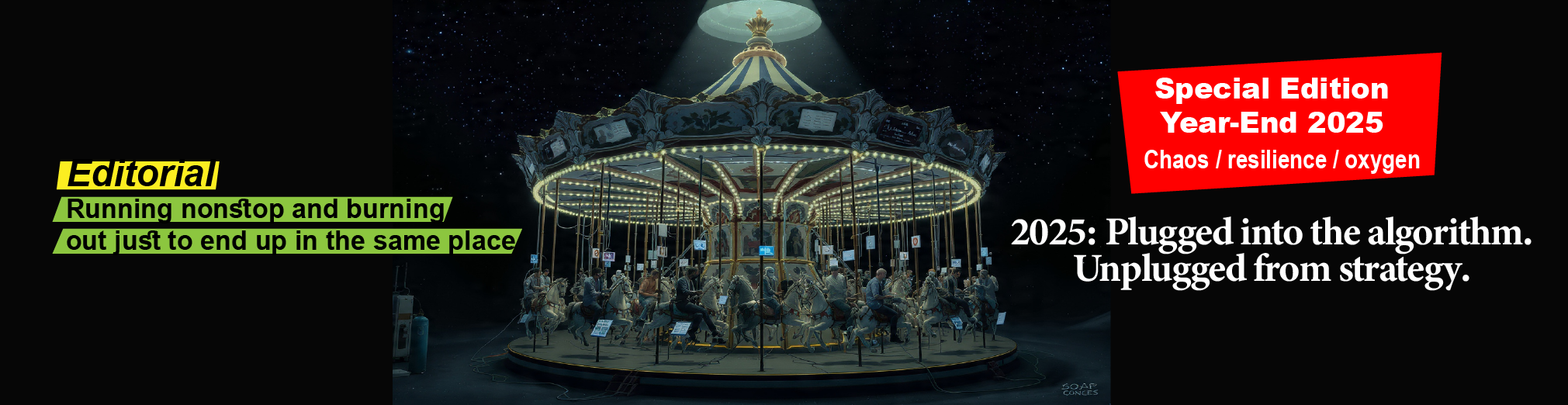

It didn’t grow. It endured. And enduring isn’t always moving forward”
Around April, there was a moment, when marketing stopped looking like a creative industry and started looking like an emergency room. Briefs arrived like defibrillators. Teams were hooked up to the algorithm’s drip. There was a widespread atmosphere of “we have to be everywhere, if we aren’t, we don’t exist.”
2025 showed us with brutal honesty what happens when we confuse movement with progress, and activity with growth. What happens is exhaustion.
This was the year many brands delivered… but ended up gasping for air.The giants ones performed titanic transfusions on each other , like Leo Burnett and Publicis, rebranded as “LEO” in a move that tries to sound like reinvention but it seems to be more like a financial flow condenser than a new narrative.
Small businesses tried to run marathons in borrowed shoes: aspiring to do the same as the big ones but with tiny teams, symbolic budgets, and a blind faith that Instagram would solve their lives.
The result: everyone, big and small, reached December with the same feeling. We aren’t growing. We are just surviving on Wi-Fi.
And of course, Artificial Intelligence didn’t help. Well, it helped… to saturate. We were promised automation to free up time; what we got was an avalanche of dashboards, prompts, and empty phrases about “creative co-pilots.” In practice, we were turned into nervous operators, not liberated thinkers. 2025 marketing looked like an assembly line with GPT shoved into every gear.
The problem isn’t AI itself. It’s the fantasy that it can replace strategy, which ended up exhausting what little collective judgment was left.
We saw hyperactive brands on “more-is-more” syndrome. As a former Ogilvy CEO once said between hallways and drinks at Cannes: “Most brands are saying something all the time, but they aren’t saying anything at all.”
A prime example was Prime Hydration, the drink with more hype than electrolytes which went from cult status to the discount shelf in less than six months. The fall was as abrupt as it was predictable: without a real foundation of value, it was all just foam.
In entertainment, brand management wasn’t any better. Netflix bought Warner like someone buying a ZIP file without knowing what’s inside, concentrating historic franchises in the hands of an algorithm. And as if that weren’t enough, they gave us the narrative corpse of The Witcher. Changing the protagonist like a TikTok filter wasn’t a casting decision; it was a suicide of brand loyalty. Nobody wants to see their passions corporatized.
And what about SMEs?
Small and medium-sized enterprises did what they could. Most ran aimlessly chasing trends and hashtags. But there were a few lucid ones that decided to stop, to observe, to invest in strategy before likes. And there, in that minority, were true stories of transformation. Local coffee shops that became national brands with well-targeted ads; neighborhood businesses that found new audiences without losing their identity.
It wasn’t magic. It was focus.
If this year taught us anything, between awards and paralysis, it’s that authenticity isn’t a trend; it’s an inevitable return. Consumers are no longer just exhausted by overexposure; they are learning to distinguish the real from the conveniently programmed.
Movistar Mexico understood this well with its “SHOUT” campaign, earning not only awards at Cannes but also respect. Because when the message has a soul, it doesn’t need a disguise.
So, what does 2025 leave us with?
It leaves us with the hangover of a meaningless race, but also some notes on the napkin of the future:
Not everything that shines is engagement.
Not everything that automates provides relief.
And not everything that is measured, matters.
Perhaps the most valuable thing about the year wasn’t what we did, it´s what we learned to stop doing. Silence as a brand act. The pause as a strategy. And redesigning from the inside out, not from the feed.
January will come with its predictions, decks full of trends, and gurus announcing the next disruption in gradient-filled slides. For now, it’s time to close this cycle. To thank the chaos for what it taught us. And to accept that perhaps the most revolutionary thing for 2026 will be to grow, yes… but with purpose.
Happy New Year if you celebrate it. And if not, at least may the algorithm treat you better.
Óscar Aviv Rodríguez
Editor-in-Chief
Garage Marketing