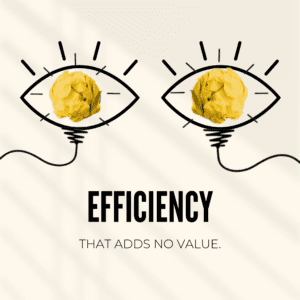
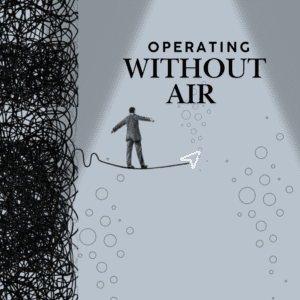
During 2025, a significant portion of marketing and creative businesses operated under a logic that, viewed from a distance, feels paradoxical: execution reached unprecedented levels, while questioning nearly disappeared. Clear briefs, optimized processes, automated flows, on-time deliverables. Everything worked… except meaning.
For those of us who work with—and study—innovation not as a trend but as a discipline of transformation, the year left a clear signal: the problem was not a lack of creativity, but a lack of judgment. Innovation was confused with speed, and sophistication with volume. The brief stopped being a starting point and became a tacit boundary.
Yet 2025 also produced relevant examples of a different kind of practice: organizations and teams that understood that innovation does not consist of executing the brief better, but of redefining the brief when it no longer responds to the real problem.
When the brief describes the symptom, but not the disease
From a business innovation perspective, the traditional brief tends to capture operational needs rather than structural tensions. It defines objectives, audiences, channels, and KPIs—but it rarely asks the right question: What needs to change in the system for this problem to stop existing?
In 2025, many brands followed flawless briefs that produced more of the same: platform-optimized content, campaigns designed to feed dashboards, ideas calibrated to avoid discomfort—whether for the algorithm or the client. The result was efficiency without direction.
The cases that truly made a difference shared a strategic decision: pausing execution to reinterpret the problem frame.
Latin American Case: Natura and The Amazon Greenventory
Innovating not in the message, but in the architecture of value
The Amazon Greenventory project, developed by Natura in partnership with Africa Creative DDB, is a paradigmatic example of innovation understood as systemic redesign.
The initial brief could easily have led to yet another sustainability campaign. Instead, the team recognized that the real challenge was not communicational but structural: the lack of information and traceability that prevents sustainable economic models in the Amazon.
The solution was not a narrative, but a knowledge infrastructure—using technology to map species, generate living inventories, and enable economic decision-making rooted in active conservation. Impact was measured not only in awareness, but in installed capacity for local communities.
Its recognition at Cannes Lions 2025 was not for “creativity” in the classical sense, but for something deeper: turning innovation into an operational mechanism that alters incentives and behaviors.
Global Case: Sounds Right
When innovation means changing the language of the system
In a global landscape saturated with music campaigns and branded content, Sounds Right chose a far more ambitious conceptual path: redefining who can be considered a creator.
Driven by Spotify, in collaboration with UN Live and AKQA, the project credited “NATURE” as an artist on music platforms, channeling attention and resources toward conservation.
From an innovation standpoint, the value of the case lies not in its visibility, but in its ability to introduce a new symbolic category within an existing system. It did not optimize a format—it redefined the semantic rules of the ecosystem.
It serves as a powerful reminder: innovation does not always mean creating something new, but renaming what has always existed—and making it relevant within contemporary structures.
What these cases share (and many briefs don’t)
From both academic and practical innovation perspectives, these examples share at least four principles:
They separate execution from understanding. Before producing, they reframe the problem.
They operate at the system level, not the asset level. They aim for sustained transformation, not isolated impact.
They assume intellectual risk. They challenge assumptions held by clients, markets, or entire industries.
They understand value as a consequence, not a deliverable. Value emerges from the change they enable, not from the volume they produce.
Beyond compliance: innovation as professional responsibility
Adding value beyond the brief is neither a creative gesture nor an act of rebellion. It is, in fact, a professional responsibility when working in innovation.
Fulfilling tasks ensures operational continuity. Questioning the assignment ensures strategic relevance.
In 2025, it became clear that the difference between advanced execution and real innovation does not lie in technology, budget, or even talent. It lies in the willingness—and the capability—to say, “this problem cannot be solved this way,” and to sustain that conversation with rigor, evidence, and vision.
Only then does the brief stop being a limitation and return to what it should always have been: a starting point for thinking better.